
Nordson Dynamic Planar CT: Advancing Precision in 3D Imaging
By Dr. Andrew Mathers, Product Line Manger AXI
 Advancements in semiconductor and PCB manufacturing have necessitated 100% inspection that guards against critical defects that could cause problems down the line. Historically, many manufacturers have relied on 2D radiographic imaging for their inspection needs. But as manufacturing requirements become ever more stringent and the quality and the reliability of devices increases to meet supplier demands, 3D imaging has become the optimal solution by driving higher performance inspections with better resolution and quality. This is where Nordson’s Dynamic Planar CT comes in.
The Challenges of Planar X-ray Imaging
3D imaging has been around for a while in electronics imaging, but it is still challenging to achieve high quality results. One of the biggest challenges in planar scanning, also known as laminography, is that image artefacts can occur, i.e. features or distortions in the images that do not exist in reality. Due to the flat planar nature of most electronics samples with densely packed, overlapping components plus the rotation of the sample for computed tomography, building an artifact free 3D volume of acquired images is very challenging. These artefacts make it difficult to clearly visualize the different layers and fine features in electronic samples, which is essential for high quality inspection in this industry, particularly for multi-layer printed circuit boards and flip chip semiconductor back end devices.
With traditional laminography, manufacturers tend to have a static X-ray source and detector and rotate their sample, however Nordson’s Dynamic Planar CT rotates both the sample and the detector in a motion around the point of inspection ROI (region of interest) providing significantly improved image quality, enabling clear layer discrimination and defect detection. The reconstruction of this scan is a 3D volume, that provides non-destructive 3D inspection of an object’s structure, including the internal and external surfaces, plus anything in between.
How Nordson’s Automated X-Ray Inspections Address the Challenges of 3D Imaging
Nordson’s Dynamic Planar CT is a software-based product that offers high-speed, high-resolution 3D imaging of electronic devices to identify critical defects during production, particularly in the semiconductor and SMT market. Dynamic Planar CT boasts a significant acceleration in acquisition time, up to 2 times faster than Planar CT, the previous generation of Nordson’s 3D inspection. This offers significant benefits to manufacturers, as it has much higher throughput and much higher units per hour (UPH), reducing quality control delays in the production process.

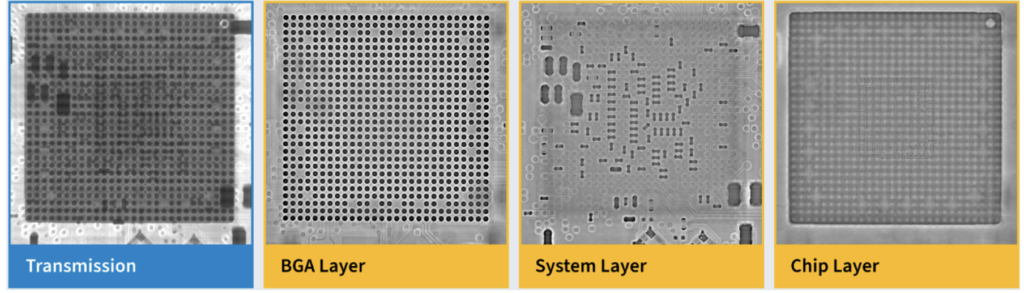 Dynamic Planar CT still uses laminography, but with a slightly different image capture process. It’s far smoother and uses a much wider field of view allowing for inspections that acquire images of a much wider area. This means the process can be completed much more quickly and reduces cycle times. It also means manufacturers reduce the radiation dose which samples receive during their inspection. This is particularly important for radiation-sensitive devices, such as high-bandwidth memory. Dynamic Planar CT takes an orbit with a detector that sweeps around the point of inspection, and allows for many, many more 2D radiographic images (projections) to be acquired, providing significantly improved image quality. Additionally, vibrations during scanning are virtually eliminated, removing the need for special clamping of electronic carriers (BGAs/wafers/flip chips) and with it, reducing the cost of ownership. This acquisition approach combined with a brand-new proprietary reconstruction algorithm offers superior speed and quality for 3D X-ray inspection.
Inline Efficiency: The Case for Automated X-Ray Inspection
Manufacturers who use automated X-ray inspection (AXI) value speed and quality. For example, requirements for automated inspection typically involve capturing 3D scans, reconstructing the data and performing image analysis in just a few seconds. This is key to inline manufacturing, where a short tack time and high throughput is essential. To facilitate maximum units per hour, samples are typically fed into AXI systems on a conveyor belt or via a loader—like a magazine loader one might find in a semiconductor fab environment. The samples are inspected and then fed out of the other side of the system (pass through), or returned to the same side as they were loaded (single side) whilst the conveyor/magazine loader, loads the next sample. Conversely, with manual X-ray inspection (MXI), operators typically have to load samples by hand on a tray or individually into an inspection area. Then, they manually start the inspection routine within the system software, wait until the scan is completed, and then exchange the sample(s).
Implementing Dynamic Planar CT in the Manufacturing Process
 Currently, one of the biggest movements in the manufacturing world—and in electronics in particular—is called Quality 4.0 / Industry 4.0. The focus here is not on identifying errors during the production process. The aim is to prevent errors from occurring in the first place. Eliminate them before they occur! Modern smart factories are highly networked environments with continuous, two-way data flow. This means that defects can be mitigated before they enter the production process. It’s important to manufacturers to not spend a lot of time making that adjustment. The preference is to ensure the product coming through is of the quality needed to make the final cut and be sent to the end customer without rework or scrapping.
As such, Dynamic Planar CT is exceptionally useful for semiconductor backend or SMT factory lines, excelling at void inspection in ball grid arrays, printed circuit board solder joints and voiding in flip chip micro bumps. Being able to clearly discriminate between each layer of the sample and visualize voiding in super high resolution, without interference from artifacts from neighboring or dense components is highly valuable for manufacturers.
With this level of detail manufacturers can identify these defects and pull impacted samples off the line, preventing additional processing before they end up being packaged into a device that later fails. The entire purpose of Dynamic Planar CT is to ensure that products that aren’t of the necessary quality to perform at a high level will be identified and removed from the manufacturing process to ensure the end customer only receives products of highest quality that will perform at the top level.
High Speed, high resolution and high quality across Nordson’s AXI Portfolio
 current portfolio of automated X-ray solutions can be split into three categories, with three different system series that serve different markets. There’s the XS series, which focuses on the semiconductor backend market; the X series for SMT; and the X# series, which supports two markets: the power hybrid market and the final assembly, test and pack (FATP) market. However, what these systems and markets have in common is they all require high speed, high resolution and, most critically, high quality imaging with critical defect inspection analysis driven by our advanced in-house algorithm library. Nordson has a direct presence in over 35 countries worldwide, working with the biggest names in the world of electronics. Nordson also has an installation base in excess of 2000 AXI systems alone.
