
Portable Air Filtration Systems: Capturing and Cleaning Contaminants at the Source
By Gerald Gardener
Portable air filtration systems are a key component of modern workplace air quality control, particularly in electronics manufacturing, light industrial production, laboratories, and maintenance environments. Their effectiveness lies not in diluting polluted air into the room, but in capturing contaminants directly at the point of generation, before they disperse into the breathing zone.
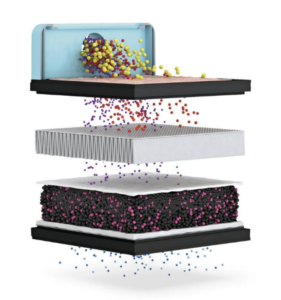
At a fundamental level, a typical portable air filtration system consists of three core elements: an extraction interface (usually a hose or articulated arm), a multi-stage filter assembly, and a blower. While this architecture appears simple, the interaction of these components allows such systems to remove particulate and gaseous contaminants so effectively that the cleaned air returned to the room is often lower in particulate concentration than the surrounding indoor ambient air at the point of use.
System Architecture: Hose, Filter, and Blower
Source Capture Through Localized Extraction
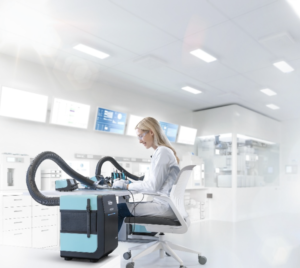
 The extraction hose or arm is positioned as close as practicable to the emission source such as a solder joint, adhesive bead, or chemical process. This localized capture prevents contaminants from spreading into the surrounding workspace, reducing operator exposure, and lowering the overall contaminant load that the filtration system must handle.
The Blower
The blower generates the airflow required to draw contaminated air through the extraction hose and push it through the filter stages. Portable filtration units typically use blowers optimized for relatively high static pressure rather than sheer airflow volume, enabling them to maintain stable extraction performance even as filters load over time.
While airflow is often the first specification people focus on when comparing filtration systems, flowrate alone tells you very little about whether a unit can filter gases effectively. What truly matters is the airspeed through the gas filtration media. If the air passes through too quickly, it doesn’t remain in contact with the gas media long enough for meaningful adsorption to take place. This “dwell time” is essential for removing chemical contaminants, yet many low‑cost systems ignore it entirely, prioritizing impressive‑sounding flowrate numbers over real filtration performance. Well‑engineered systems, by contrast, carefully balance blower performance, filter geometry, and media volume to maintain an optimal airspeed through the filter. This ensures that contaminants have the necessary contact time with the gas media, delivering genuine gas‑phase filtration rather than just moving large volumes of air.
The Filter Assembly
The filter system is the functional core of the unit. Modern portable systems employ a staged filtration approach, with each stage targeting different contaminant types and sizes to maximize efficiency, reliability, and service life.
The Three Functional Stages of Filtration
1. Prefilter – Extending Filter Life
The prefilter is the first filtration stage encountered by the contaminated air. Its primary purpose is to capture coarse and fine particulate matter before it reaches the HEPA filter, thereby protecting the downstream stages from premature loading.
Typical contaminants captured at this stage include dust, smoke agglomerates, flux residues, and larger solder fume particles. By removing these early, the prefilter significantly extends the service life of the HEPA filter and helps maintain consistent airflow.
Prefilter Grades Explained
Prefilters are now commonly classified according to ISO 16890, which replaced the older EN 779 system. ISO 16890 ratings are based on particulate size fractions relevant to human health: PM10, PM2.5, and PM1.
An ePM1-75% rating indicates that the filter removes at least 75% of particles with an aerodynamic diameter of 1 micrometre or smaller.
The prefilter used in the ZeroSmog Guard unit is rated ePM1-75%, which is broadly equivalent to an F8 filter under the former EN 779 standard. This level of efficiency is well suited to applications such as soldering, where fine particulate emissions dominate.
2. HEPA Filter – High-Efficiency Particle Removal
Following the prefilter, air passes through a HEPA filter, which is responsible for removing extremely fine and health-relevant particles.
Guard filtration units employ H13 HEPA filters, which remove at least 99.95% of particles at the most penetrating particle size (approximately 0.3 µm). This includes:
• Ultrafine solder fume particles
• Metal oxides
• Combustion by-products
• Other respirable particulates
After HEPA filtration, the particulate content of the air is typically lower than that found in most industrial or office environments.
3. Gas Filter – Chemical Contaminant Removal
 Many industrial processes emit gaseous contaminants that cannot be captured by mechanical filtration alone. These include volatile organic compounds (VOCs), aldehydes, acids, and other chemically active or odorous gases.
Gas filters operate through adsorption and chemisorption, rather than physical interception. Activated carbon (AC) is the most common gas filtration medium.
Imagine holding a granule of activated carbon in your hand, about the size of a small pea. Tiny as it is, and weighing only a tenth of a gram, its internal surface area is enormous because of its microscopic pores. In a single ZeroSmog Guard gas filter, thousands of these granules combine to create a total internal surface area equivalent to more than a hundred soccer pitches, all packed into an enclosure no larger than a shoebox. It’s this incredible surface area that allows activated carbon to capture gases and vapours far beyond what its external size might suggest.
In some configurations, chemically active additives are included to target specific gas families more effectively.
It is important to note that gas filtration performance is highly dependent on the specific chemical species, concentration, temperature, humidity, and exposure time.
End users should always assess the suitability of a given gas filter for their application by reviewing substance safety data, conducting a risk assessment, and consulting the filtration equipment supplier or a qualified industrial hygienist where necessary.
Balanced Filter Set Design in the Guard System
A defining characteristic of the ZeroSmog Guard filtration concept is its balanced filter life philosophy. The system is designed such that, under typical applications, the filter set will achieve its intended service life over the equivalent of three prefilter change intervals.
In practical terms, this means that the HEPA and gas filter stages are expected to remain effective for approximately the service life of three prefilters. At this point, the gas media is often approaching saturation while the HEPA filter is nearing its optimal loading limit.
However, because actual contaminant loads vary widely between applications, five prefilters are supplied with each filter set. This allows flexibility for users whose processes may generate higher-than-average particulate emissions, without compromising HEPA or gas filter performance. The additional prefilters account for uncertainty in real-world use cases rather than indicating a longer intended filter life.
Filter Saturation and System Monitoring
Particle Filters: Pressure-Based Monitoring
As prefilters and HEPA filters accumulate particulate matter, the resistance to airflow through the system increases. Guard filtration units continuously monitor this pressure drop across the filter stages. When defined thresholds are exceeded, the unit activates:
• Visible status indicators
• Audible warning signals
This monitoring ensures that particle filters are replaced at the appropriate time, maintaining consistent extraction performance and preventing unnoticed degradation of airflow and capture efficiency.
Gas Filters: Practical Limitations
Gas filters do not show a measurable pressure change as they become saturated, and remaining adsorption capacity cannot be inferred from airflow resistance. Considering the vast number of different gases in existence, there is currently no compact, economically viable sensing technology in common use within portable filtration systems that can reliably indicate the saturation state of multi-gas adsorption media under real operating conditions.
As a result, gas filter replacement is typically based on expected service life, process knowledge, and risk assessment. In applications involving odorous substances, gas breakthrough may be detected through sensory cues such as smell or irritation, which indicate that adsorption capacity has been exceeded. Such detection is qualitative and subjective, and where accurate assessment of gaseous contaminants is required, appropriate analytical monitoring and professional exposure evaluation should be used.
Guard Filter Options: Application-Specific Configurations
Guard filtration units are available with three compatible filter configurations, allowing the system to be matched to the dominant contaminant profile.
Normal Filter – Activated Carbon
This configuration uses activated carbon as the gas filtration medium and is highly effective for soldering fumes and flux decomposition products.
It also provides varying degrees of effectiveness against VOCs, including solvents, adhesives, surface cleaners, fuels, and fragrances. Performance against other chemical gases is generally lower and strongly dependent on the specific compounds involved.
Wide Band Filter – Broad Chemical Coverage
The Wide Band filter is designed for applications involving a wider variety of gaseous contaminants. Its gas media consists of a mixture of activated carbon and potassium permanganate (KMnO₄).
This combination provides:
• Excellent performance for soldering fumes
• Strong effectiveness against many VOCs
• Effective against many representatives of these gas classes, depending on concentration and operating conditions: acid gases, inorganic gases, halogenated compounds, ozone, ammonia, and certain aerosolized reactive gases
The chemically active component enables neutralization reactions in addition to adsorption.
Adhesives Filter – Maximum Gas Media Volume
The Adhesives filter is intended for applications dominated by gaseous emissions, such as bonding, coating, and solvent-based processes. It uses a gas media formulation similar to the Wide Band filter but omits the HEPA particle filter.
By eliminating the HEPA stage, nearly the entire internal volume of the filter can be devoted to gas media, significantly increasing the available gas media volume, enabling substantially longer gas filtration service life. This results in:
• Significantly extended gas filter service life
• Improved performance in adhesive- and solvent-heavy applications
• Reduced frequency of gas filter replacement
This configuration is best suited to processes with minimal particulate generation.
Conclusion
Portable air filtration systems are precision-engineered tools rather than simple air movers. When properly selected and applied, they provide effective source capture, multi-stage contaminant removal, and intelligent monitoring, returning air that is lower in particulate and/or gaseous contaminants than the surrounding ambient air.
By understanding filter classifications, the rationale behind balanced filter sets, and the limitations inherent in gas filtration monitoring, users can make informed decisions that optimize both performance and operating cost. In environments where occupational exposure control and indoor air quality are increasingly scrutinized, portable filtration systems remain a proven and practical engineering solution.
For more information, contact Gerald Gardener at Gerald.Gardener@Weller-Tools.com or visit www.weller-tools.com.
